Yard planning guide
Low-Maintenance Backyard Landscaping
Real low-maintenance backyard ideas by USDA zone: drought-tolerant plants, lawn vs mulch vs gravel costs, and the mistakes that backfire.
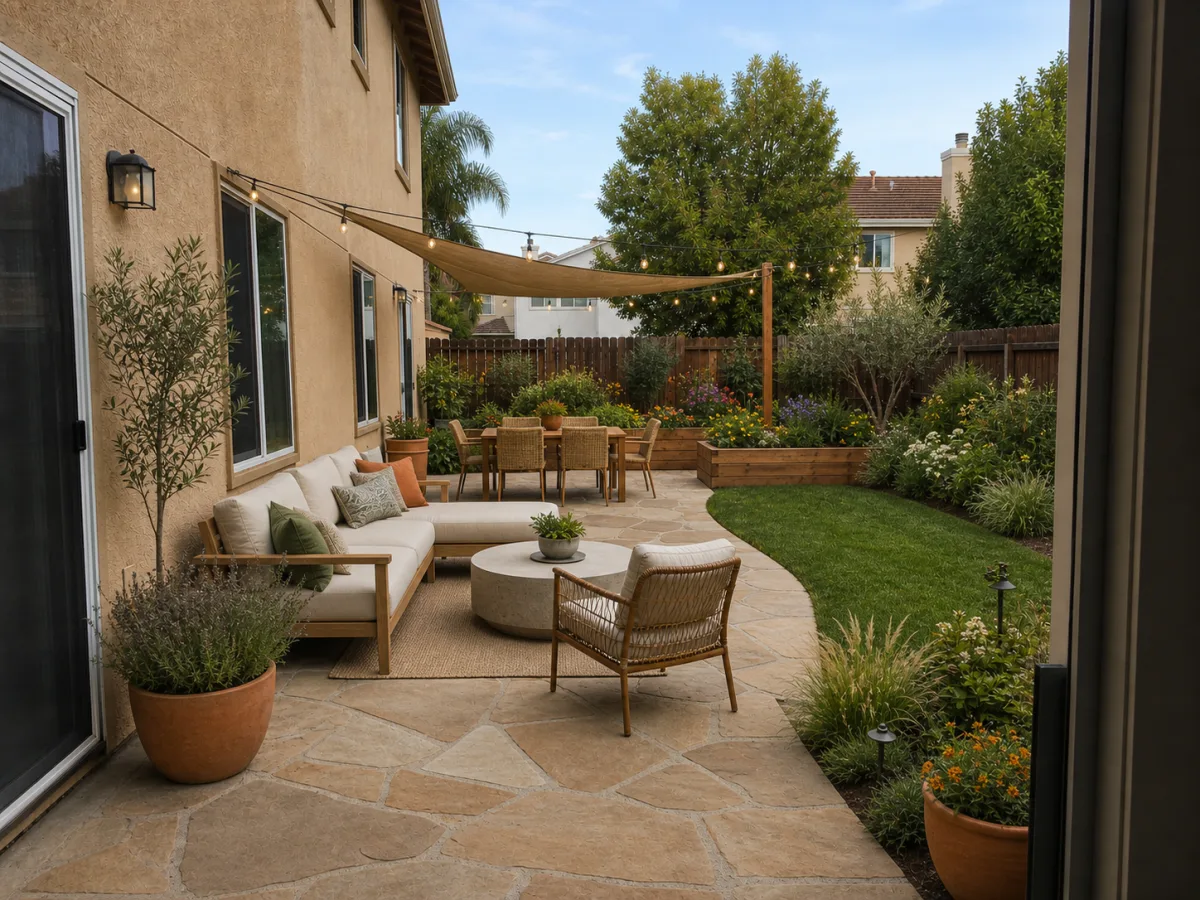
The shortest honest answer: a truly low-maintenance backyard is one where you shrink the thirsty, fast-growing parts (lawn and annual flower beds) and replace them with regionally adapted plants, deep mulch, and durable ground surfaces that mostly take care of themselves. Choose species that match your USDA hardiness zone and your light and soil conditions, give them one season to establish, and the ongoing work drops to occasional pruning, a yearly mulch top-up, and a quick weed pass. The expensive maintenance trap is the opposite: a big lawn plus exotic plants that need constant water, feeding, and mowing. For the full picture of how the whole yard fits together, see our guide on AI backyard design.
This article is about the horticulture and materials themselves — what to plant, what to pave, what it roughly costs, and where “low-maintenance” quietly turns into “high-maintenance” when you get a detail wrong. If you also want to test layouts visually before committing, you can preview ideas with AI Yard Planner, but the knowledge below stands on its own.
What “low-maintenance” actually means
Low-maintenance is not “no plants” and it is not gravel from fence to fence. A yard that is all hardscape bakes in summer, sheds stormwater badly, and still grows weeds in the joints. The goal is a balance: living plants that are matched to your climate so they don’t need babying, plus surfaces and mulch that suppress weeds and hold moisture.
Three levers do most of the work:
- Right plant, right place. A species adapted to your zone, sun exposure, and soil drainage will largely self-regulate. The wrong plant fights its environment forever, and you pay for that fight every weekend.
- Reduce the high-input zones. Lawn and annual beds are the most demanding square footage in any yard. Shrinking them — not eliminating them — is the single biggest maintenance reduction available.
- Cover bare soil. Bare soil is an invitation to weeds and evaporation. Mulch, groundcovers, or considered hardscape close that gap.
Step 1: Find your zone and read your site
Before buying a single plant, confirm your growing zone with the official USDA Plant Hardiness Zone Map. The zone tells you the coldest winters a plant must survive, which is the first filter for “will this come back every year without replacement.”
Then read your actual site for a few days:
- Sun: Track which areas get full sun (6+ hours), part sun (3–6), and shade (under 3). Most drought-tolerant and prairie-style plants want full sun; forcing them into shade is a classic failure.
- Drainage: After rain, note where water pools. Slow-draining clay kills many “easy” Mediterranean plants by rotting their roots, while it suits native rushes and sedges.
- Slope and aspect: South- and west-facing slopes are hotter and drier; north-facing and low spots stay cooler and wetter. Group plants by these microclimates.
These observations matter more than any plant list, because the same species can be effortless in one corner and a constant struggle ten feet away.
Step 2: Pick plants that match your zone
Below are categories that consistently lower workload, with real species and the rough zones where they thrive. Always cross-check a specific cultivar against your local conditions, and prefer plants native to your region wherever possible — you can look up what’s truly local with the NWF Native Plant Finder.
Ornamental grasses (structure with almost zero care)
Once established, ornamental grasses ask for nothing but a single cut-back in late winter.
- Little bluestem (Schizachyrium scoparium) — a North American native, zones 3–9, full sun, superb blue-green summer color turning copper in fall. Tolerates poor, dry soil.
- Switchgrass (Panicum virgatum) — native, zones 4–9, upright and tough, handles both dry and periodically wet ground.
- Blue fescue (Festuca glauca) — zones 4–8, tidy silver-blue mounds for edging, wants sharp drainage.
- Feather reed grass (Calamagrostis × acutiflora ‘Karl Foerster’) — zones 4–9, vertical accent, very forgiving.
Native perennials (color that returns on its own)
Native perennials are the backbone of a low-input, pollinator-friendly bed.
- Purple coneflower (Echinacea purpurea) — zones 3–8, full sun, drought-tolerant once established, seedheads feed birds.
- Black-eyed Susan (Rudbeckia fulgida) — zones 3–9, long bloom, spreads gently to fill space.
- Butterfly milkweed (Asclepias tuberosa) — zones 3–9, deep taproot makes it extremely drought-hardy and essential for monarchs.
- Russian sage (Perovskia atriplicifolia) — zones 4–9, silver foliage, thrives in lean dry soil and heat.
- Yarrow (Achillea millefolium) — zones 3–9, ferny foliage, tolerates drought and poor soil.
Drought-tolerant shrubs (low pruning, high payoff)
- Manzanita (Arctostaphylos spp.) — zones 7–10 (West), evergreen, beautiful bark, very low water once established.
- Texas sage / cenizo (Leucophyllum frutescens) — zones 8–10, silvery, blooms after rain, ideal for hot dry climates.
- Smokebush (Cotinus coggygria) — zones 4–8, dramatic foliage, tolerates poor soil.
- Inkberry holly (Ilex glabra) — zones 4–9, evergreen native, good for the cooler, slightly damper East.
Groundcovers (the weed-suppressing lawn alternative)
- Creeping thyme (Thymus serpyllum) — zones 4–9, walkable, fragrant, drought-tolerant in sun.
- Sedum / stonecrop (Sedum spp.) — zones 3–9, succulent, nearly indestructible in dry sun.
- Pennsylvania sedge (Carex pensylvanica) — zones 3–8, a soft “no-mow lawn” feel for shade.
The pattern across all of these: native or regionally adapted, sun-and-drainage matched, and drought-tolerant once established. That last phrase is doing heavy lifting — see Step 4.
One more design principle keeps a planted bed low-effort: plant densely and in drifts rather than dotting single specimens across bare mulch. Closely spaced plants knit together as they mature, shading the soil so weed seeds never get the light they need to germinate. A bed planted at proper spacing fills in within a season or two and then largely weeds itself, while a sparse bed leaves open ground that you’ll be weeding for years. Repeating a small palette of three to five reliable species in larger groups also looks more intentional and is far easier to care for than a one-of-everything collection, because every plant in a group wants the same water, light, and pruning at the same time.
Step 3: Choose your ground surfaces wisely
The non-planted areas decide how much weeding and watering you’ll do. Here is a directional comparison. Costs are rough U.S. ranges and vary a lot by region, material quality, prep work, and labor — treat them as ballpark, not quotes.
| Surface | Rough cost (per sq ft, installed) | Ongoing maintenance | Water need | Best for |
|---|---|---|---|---|
| Traditional lawn | $1–$2 (seed/sod) | High — mow weekly, feed, edge, water | High | Play areas, formal looks |
| Mulch bed (wood/bark) | $2–$5 | Low — top up ~yearly, occasional weed | Low | Planting beds, tree rings |
| Gravel / decomposed granite | $3–$8 | Low–medium — rake, refresh, weed joints | None | Paths, dry zones, xeriscape |
| Groundcover planting | $4–$10 | Low after fill-in — light trim | Low | Replacing lawn, slopes |
| Pavers / flagstone | $15–$30+ | Very low — sweep, occasional joint weed | None | Patios, high-traffic |
A few practical notes behind the table. Mulch is the cheapest workload-reducer per dollar: a 2–3 inch layer of bark or wood chips smothers most weeds and cuts evaporation dramatically. Coarser, longer-lasting mulches like shredded hardwood or bark nuggets break down more slowly and need topping up less often than fine mulches, which is worth the small extra cost if low effort is the goal. Gravel and decomposed granite look “permanent” but weeds will colonize the surface over time unless you keep the layer thick and edged — and they radiate heat, so don’t ring heat-sensitive plants with them. Pavers cost the most up front but are genuinely close to zero maintenance for decades, which is why a smaller paved patio plus mulched beds often beats a large lawn on lifetime effort.
It’s also worth thinking in terms of lifetime cost rather than install price. A lawn is cheap to put in but expensive to keep — every season of mowing, fuel, fertilizer, and water adds up, and that bill never stops. A paver patio or a well-planted, mulched bed costs more on day one but its running cost falls toward zero. Over a five- to ten-year horizon, the “expensive” low-maintenance option is frequently the cheaper one, and it buys back your weekends on top.
Step 4: Irrigation and mulch — the establishment phase
The most common reason “low-maintenance” plants die is that people skip establishment. Even drought-tolerant natives need regular water for the first full growing season (sometimes two for shrubs) while roots reach down. After that, most can ride out dry spells on rainfall plus occasional deep soaks.
Two rules make this easy:
- Water deeply and infrequently. A long, slow soak that wets the root zone trains roots to grow down, which is what makes a plant drought-proof later. Frequent shallow sprinkling does the opposite. A simple drip line on a timer is the lowest-effort way to get water establishment right. The EPA WaterSense landscaping guide has solid, vendor-neutral guidance on efficient watering and plant choice.
- Mulch 2–3 inches deep, and keep it off the stems. Mulch holds moisture, moderates soil temperature, and blocks weeds. But piling it against trunks (“mulch volcanoes”) traps moisture against bark and invites rot and pests. Leave a few inches of clearance around every stem and trunk.
Why native and xeriscape designs save water and work
Xeriscaping is often misunderstood as “rock and cactus.” It really means landscaping designed to minimize supplemental irrigation: regionally appropriate plants, grouped by water need, over efficient soil and mulch. Native plants are central to this because they evolved with your local rainfall, soils, and pests — so they typically need less water, less fertilizer, and almost no pesticide once established.
There’s an ecological dividend too. Native plantings support far more local insect and bird life than exotic ornamentals, and choosing pollinator-friendly natives turns a low-maintenance yard into useful habitat. The Xerces Society’s pollinator conservation resources are a good starting point for picking plants that do double duty. The same instincts that make a yard easy to maintain — adapted plants, less lawn, less chemical input — also make it better for water tables and wildlife.
If you’re applying these ideas to a smaller or more design-forward space, the principles carry over directly to ornamental plantings; our AI garden design overview shows how the same plant-and-surface logic scales down to beds and borders.
When low-maintenance backfires
“Low-maintenance” is a property of good decisions, not a product you can buy. Here is where it quietly turns into the opposite:
- Wrong plant for the zone or site. A sun-lover stuck in shade, or a Mediterranean shrub in soggy clay, will sulk, get diseased, and need constant intervention or replacement. This is the number-one failure. Match species to zone, sun, and drainage every time.
- Poor drainage. Many drought-tolerant plants tolerate dry far better than wet feet. If water pools, either amend and grade for drainage, build raised beds, or switch to plants that accept wet soil. Ignoring drainage rots roots no matter how “easy” the plant is.
- Invasive species. Some “tough, spreads fast, fills in quickly” plants spread too well and become a permanent management headache — and can escape into natural areas. Avoid known invasives for your region (English ivy, running bamboo, Japanese barberry, and others depending on location); check your state’s invasive plant list before planting anything that’s sold as aggressive groundcover.
- Skipping establishment. As noted, even tough plants need that first season of water. Plant a drought-tolerant garden, walk away in July, and you’ll be replanting in fall.
- Too much hardscape. All-gravel or all-paver yards seem like the ultimate shortcut, but they create heat islands, worsen runoff, and still grow weeds in the gaps. A mix outperforms an extreme.
- No edging. Without a clean edge between bed, lawn, and path, everything migrates into everything else and weeding never ends. Simple steel, stone, or trench edging removes a whole category of ongoing work.
Plan around these and the design stays easy for years. Ignore them and you’ve simply moved the labor, not removed it.
Putting it together
A reliable low-maintenance backyard usually looks like this: a modest lawn or no-mow groundcover where you actually use it, a paved patio for sitting, and the rest given over to mulched beds of zone-matched native perennials, grasses, and drought-tolerant shrubs grouped by their water and light needs, on a simple drip line for the establishment years. That combination front-loads a season of effort and then mostly maintains itself.
Two more articles will help you execute: read how to photograph your yard for AI landscape design before you plan layouts so you’re working from accurate site conditions, and front-yard curb appeal on a budget for cost-smart ways to apply these same plant-and-surface ideas out front.
One honest caveat: any layout you generate from a photo — including with AI Yard Planner — is a visual concept, not a construction document or permit. Before you dig, verify drainage, sun exposure, slope, utility lines, and local permit requirements with a professional or your municipality. Software is great for picturing the result; the ground truth still belongs to your site. For the broader strategy that ties planting, layout, and cost together, return to our AI backyard design guide.
FAQ
What is the lowest-maintenance backyard ground cover that isn’t grass?
For sunny areas, creeping thyme, sedum, and ornamental gravel over landscape-appropriate beds are the lowest-effort options; for shade, Pennsylvania sedge gives a soft no-mow look. Living groundcovers need a season to fill in but then suppress weeds on their own, while gravel needs occasional raking and a thick layer to keep weeds out of the joints. The right choice depends on sun, foot traffic, and your zone.
Are drought-tolerant plants really no-water?
No — “drought-tolerant” means low water after establishment, not zero water ever. Nearly all of these plants need regular, deep watering through their first full growing season (shrubs sometimes two) so roots grow deep. After that, most survive on rainfall plus occasional deep soaks in extended dry spells. Skipping the establishment watering is the most common reason a “tough” garden fails.
Is mulch or gravel better for a low-maintenance bed?
For planting beds, organic mulch (wood or bark) is usually better: it holds moisture, moderates soil temperature, feeds the soil as it breaks down, and is cheap to refresh yearly. Gravel suits paths and true xeriscape dry zones where you don’t want decomposition, but it radiates heat and can stress nearby plants. Many yards use mulch in beds and gravel only on paths. Keep either surface 2–3 inches deep to actually block weeds.
How do I find plants that are native to my exact area?
Start with your USDA hardiness zone from the official map to filter for winter survival, then use a regional native-plant database like the NWF Native Plant Finder to see species genuinely local to your ZIP code. Cross-check sun and drainage for your specific spot, and favor plants flagged as pollinator-supporting. Local native-plant nurseries and extension offices are also reliable, region-specific sources.
Can I just gravel over the whole yard to never maintain it again?
It’s tempting but usually backfires. Wall-to-wall gravel or paving creates a heat island that’s unpleasant in summer, worsens stormwater runoff, and still grows weeds in the joints over time, so you trade mowing for raking and weeding. A mix — a small paved patio, mulched planted beds, and limited gravel paths — looks better, drains better, stays cooler, and is genuinely less work over its lifetime.