Yard planning guide
Front Yard Curb Appeal Costs by Project
Front yard curb appeal upgrades with a cost breakdown by project: what each upgrade costs, what it changes, and which to do first on a budget.
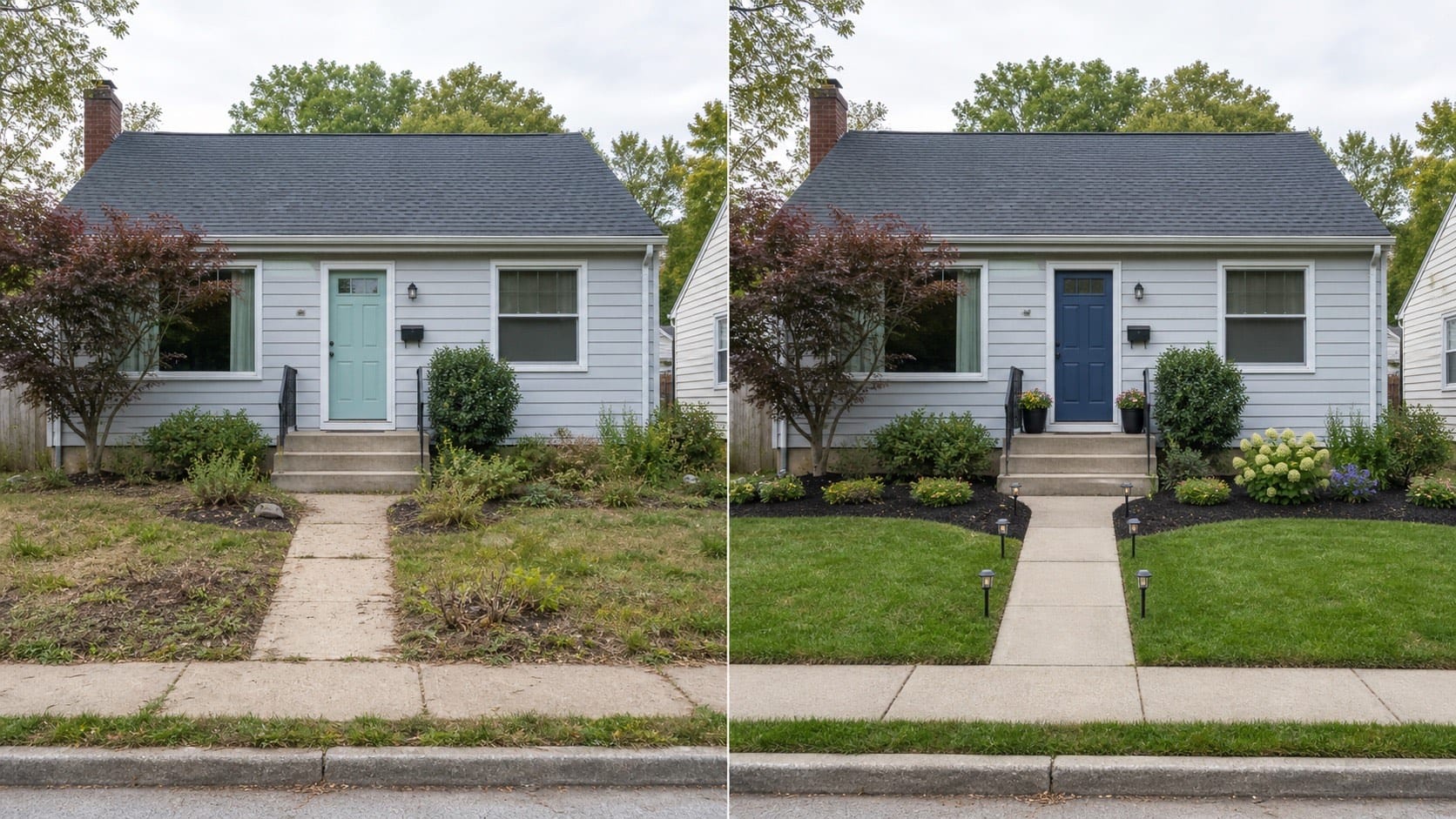
You are standing at the curb on a Saturday morning with a few hundred dollars and one weekend. The house is fine — it just reads as tired from the street. You don’t need a landscape architect or a new lawn. You need a short, specific list of projects that actually move the needle, in the order a normal person can finish them. This is that list: ten front yard upgrades that cost little and pay back in how the place looks the same afternoon. This guide is the per-project cost breakdown; our companion piece on front yard curb appeal on a budget covers the overall spending strategy behind it. A budget front yard curb appeal plan works best when you start with the visible maintenance signals before adding expensive plants or hardscape.
If you are weighing cheap front yard upgrades or comparing low cost curb appeal ideas, start with the strategy behind where each dollar goes furthest — what to do first and what to skip — in our companion piece on front yard curb appeal on a budget. This article is the project list; that one is the money logic. Together they make front yard landscaping on a budget easier to sequence, so you spend less and get a more coherent result.
The ten upgrades at a glance
| # | Upgrade | Typical DIY cost | Time | Skill |
|---|---|---|---|---|
| 1 | Paint the front door | $35–70 | 2–3 hrs | Easy |
| 2 | Refresh mulch | $60–180 | Half day | Easy |
| 3 | Pressure-wash hard surfaces | $40–80 (rental) | Half day | Easy |
| 4 | Add path / step lighting | $60–250 | 2–3 hrs | Easy |
| 5 | Upgrade house numbers | $15–40 | 1 hr | Easy |
| 6 | Plant a mailbox garden | $20–80 | 2 hrs | Easy |
| 7 | Flank the door with planters | $60–200 | 1–2 hrs | Easy |
| 8 | Cut clean bed edges | $0–30 (tools) | Half day | Easy |
| 9 | Plant one flowering focal point | $80–250 | 2–3 hrs | Medium |
| 10 | Refresh entry hardware + mat | $20–70 | 1 hr | Easy |
Every number above is a directional range, not a quote. Region, season, plant size, and whether you do the labor yourself swing the real cost hard. Treat them as “what order of magnitude is this,” not “what I will pay.”
A good walkthrough of the same ideas, straight from a big-box retailer, is worth a watch before you start:
1. Paint the front door
A front door is the cheapest billboard on the house. Most exterior paint runs about $35 a gallon (HGTV), and one gallon covers a door several times over. Pick a confident color that coordinates with the siding, trim, and roof tone — bold is fine, clashing is not. Scuff-sand, prime any bare spots, tape the hardware, and apply two thin coats. Proper prep is what makes a $35 job look like a $350 one and last for years.
2. Refresh the mulch
A single, consistent layer of mulch across every bed reads as “maintained” instantly and makes whatever is planted in it pop. Aim for 2–3 inches, pulled a few inches back from trunks and the foundation — piled “mulch volcanoes” against bark invite rot and pests. Buy bulk rather than bags when the volume justifies it; a 2-inch layer over 200 square feet is already about 1.25 cubic yards, and bagged mulch costs dramatically more per yard. The bulk savings often pay the delivery fee several times over.
3. Pressure-wash the hard surfaces
Driveways, walkways, fences, and siding take up as much visual area as the lawn, and grime reads as neglect. Rent a pressure washer for $40–80 a day and hit the driveway, path, and any grimy siding or gutters. Start with the least powerful nozzle and work up so you don’t etch concrete or strip paint. For oil stains on the driveway, a degreaser first makes the difference between “clean” and “still stained.” Asphalt driveways benefit from resealing every two to three years (HGTV).
4. Add path and step lighting
Lighting is the upgrade people forget and then can’t believe they lived without. Solar stakes are the zero-wiring option — stake them along the walk and at the steps for an evening “finished” feel and safer footing for guests. Low-voltage kits cost more and need a transformer, but give steadier light. Either way, the eye is pulled to a lit, obvious entry after dark, which is exactly when many visitors and buyers actually arrive.
5. Upgrade the house numbers
Faded, crooked, or tiny numbers are a small detail with an outsized effect on whether the house reads as cared-for. Modern, larger numerals in a finish that matches the door hardware run $15–40. Mount them square, at eye level near the door or on the garage, and make sure they’re legible from the street — not just from the porch. This is a 20-minute task that quietly modernizes the whole facade.
6. Plant a mailbox garden
If your mailbox sits at the street on a bare post, that little patch is free real estate. A new mailbox starts around $20 with post and concrete not much more (HGTV). Ring the post with tough, low-maintenance plants — daylilies, black-eyed Susans, rosemary, or a small clematis — so you get year-round interest for almost no upkeep. If dragging a hose out there is a chore, choose drought-tolerant varieties and skip the watering routine entirely.
7. Flank the door with planters
A matched pair of planters on either side of the entry frames the door and tells the eye exactly where to look. Use identical containers for symmetry, fill with a repeating thriller-filler-spiller mix, and swap the planting by season. This is one of the easiest ways to get a “designed” look, and because the containers are portable, you can experiment without committing a single plant to the ground.
8. Cut clean bed edges
Before you buy a single plant, do the free work: pull weeds, prune anything blocking the door or windows, and re-cut a defined, slightly trenched edge on every bed with a half-moon edger or flat spade. Crisp edges are the single highest-leverage move in the whole list — they make existing, ordinary planting look deliberate. In many yards this alone changes the first impression more than the next $300 of plants would.
9. Plant one flowering focal point
One specimen does more than a scatter of small plants. A small flowering tree or a bold shrub placed where it draws the eye toward the door becomes the anchor the rest of the bed can repeat around. Keep it matched to your USDA hardiness zone and sun exposure so it actually thrives — a plant rated outside your zone is a recurring expense, not a one-time one. Buy smaller sizes (quarts and gallons); they establish faster and cost far less than large container specimens.
10. Refresh the entry hardware and mat
New house numbers, a clean latch and knocker, and a decent doormat are the finishing touches that say “someone lives here on purpose.” Hardware in a single finish that matches the numbers ties the entry together. A worn, curling mat undercuts every other upgrade you just made, so this is the cheapest place to not cut corners.
How the costs stack up
Not every dollar buys the same impression. Roughly:
| Tier | What fits | What it buys |
|---|---|---|
| Under $50 | Edge beds, house numbers, entry hardware, mat | Instant "order" signal; reads maintained |
| $50–100 | Mulch refresh, door paint, path lighting, mailbox garden | The biggest curb-appeal-per-dollar jump |
| $100–250 | Planters, one flowering tree, low-voltage lighting | A real focal point and evening appeal |
If you only have one weekend and around $150, spend it on edging, a mulch refresh, and door paint. That trio is almost impossible to beat on cost per impression. Save the tree, lighting, and planters for round two, once the bones look intentional.
Sequence it into one weekend
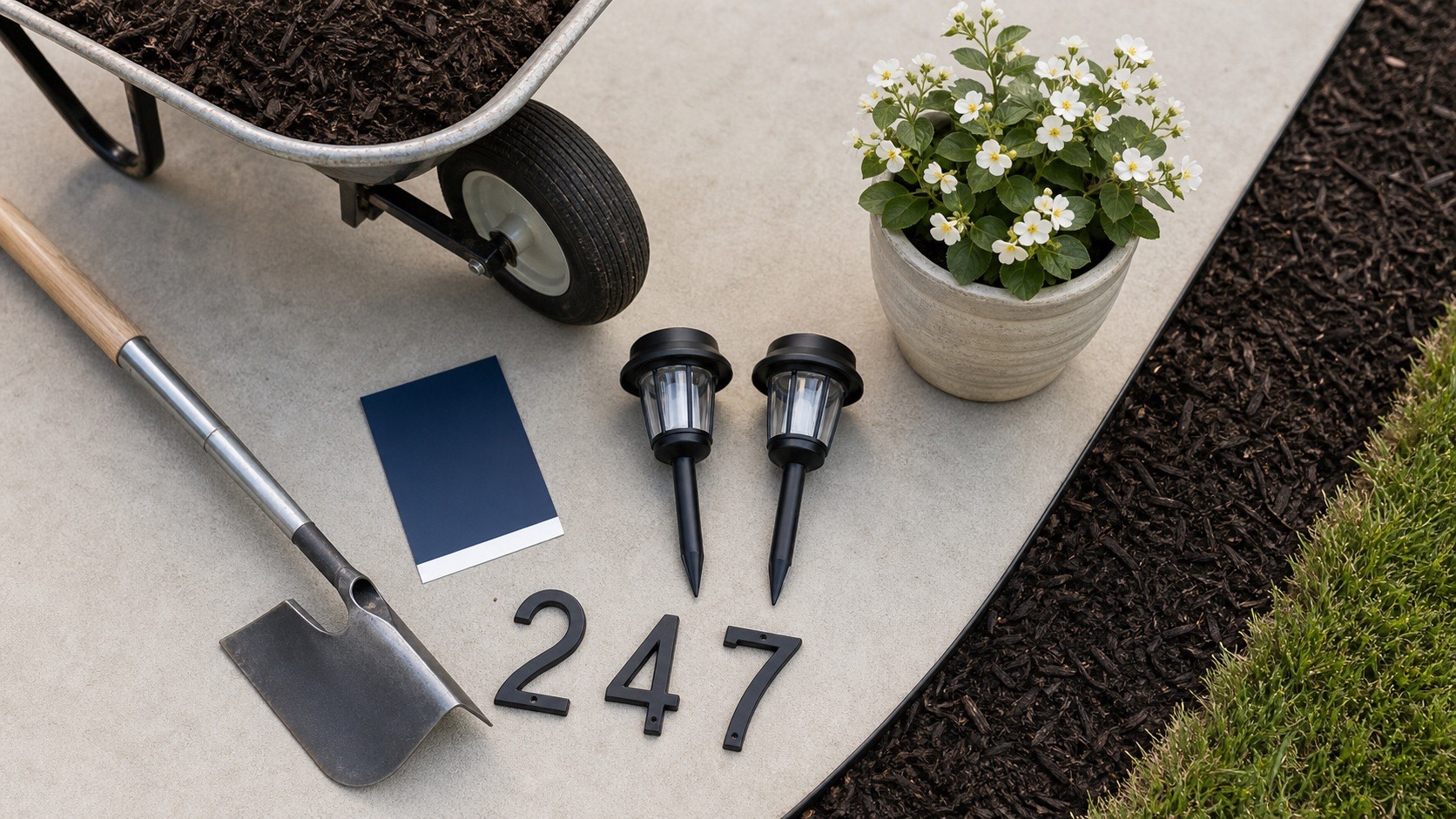
- Shoot it first. Stand where a visitor first sees the house and photograph it. The camera flattens the scene and shows what actually reads — usually clutter and fuzzy edges, not the details you notice up close.
- Subtract before you add. Remove dead plants, overgrown foundation shrubs swallowing the windows, and random pots. Subtraction is free and often the biggest single improvement.
- Edge, then mulch. Cut clean edges, then lay a consistent 2–3 inch mulch layer across all beds.
- Paint the door. One bold, well-prepped coat.
- Light the path. Stake solar lights along the walk and at the steps.
What to skip on a tight budget
Just as important as where to spend is where not to. Skip wholesale lawn replacement unless the turf is genuinely failing — patch and overseed instead. Skip water features; they’re expensive to build and maintain and barely move the curb-appeal needle. Skip annual-heavy color schemes if money is the constraint, since annuals are a recurring yearly cost — spend on perennials and shrubs that return. And skip resurfacing the driveway; a pressure-washed, edged driveway usually looks fine, and full repaving is a major cost with modest return unless it’s badly damaged.
When you choose plants, favor regionally appropriate natives and tough perennials, which the EPA’s WaterSense landscaping tips also recommend for grouping by water need and cutting thirsty turf — lower upkeep and a lusher look for less. The Better Homes & Gardens curb appeal guide and The Spruce’s budget exterior projects list more low-cost ideas if you want to extend the list beyond these ten.
See it on your own house first
You don’t have to guess how a painted door, new bed shape, or a pair of planters will land on your house. Upload a photo and preview concept images of different focal points and layouts with the AI Yard Planner, or start from the dedicated AI front yard design page. For the bigger picture on previewing exterior changes, our guide to curb appeal AI previews explains how to use generated concepts to choose a direction. Treat the output as a visual concept, not a construction plan — it won’t check your drainage, slope, sun angles, setbacks, or any local permit rules. Use it to pick a direction, then validate the practical details on site. When the back of the house is next, the same budget logic carries over to our low-maintenance backyard landscaping ideas.
FAQ
What is the cheapest way to improve front yard curb appeal? Clean, defined bed edges plus a fresh layer of mulch. It costs very little, takes a weekend, and makes existing plants look intentional. It outperforms almost any same-priced plant purchase because it fixes the “order” signal the eye reads first from the street.
How much does it cost to boost curb appeal on a budget? A meaningful refresh is achievable in the low hundreds: roughly the cost of mulch, a gallon of door paint, and a pair of planters or solar lights. Spending into the $100–250 range buys a flowering tree and low-voltage lighting. These are directional ranges that vary by region and plant size — confirm local prices before you commit.
Which front yard upgrades add the most value when selling? Tidy, neutral moves return best at sale time: edged beds, fresh mulch, a clean painted door, a healthy lawn, and working dusk lighting. Highly personal or high-maintenance features — water features, unusual color schemes, a koi pond — tend not to return their cost, so lean broad and neutral when listing.
Can I see how curb appeal changes will look before spending money? Yes. Take a clear photo from the curb and generate concept images of different focal points, bed shapes, and plantings with AI Yard Planner. The output is a visual concept, not a construction document: verify drainage, slope, sun, setbacks, and permits on site before you build.
Do solar path lights really help curb appeal? They help more than their price suggests. For $60–150 you get an obvious, lit entry after dark and safer steps for evening visitors — a “finished” signal that reads even when the lawn doesn’t. They need no wiring, so they’re a true afternoon project.